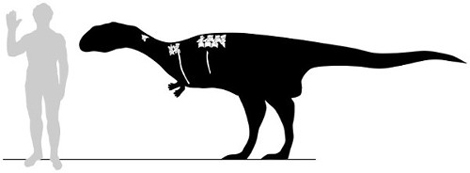
The first new species of dinosaur from Madagascar in nearly a decade was
announced today, filling an important gap in the island's fossil
record.
Dahalokely tokana (pronounced "dah-HAH-loo-KAY-lee
too-KAH-nah") is estimated to have been between nine and 14 feet long,
and it lived around 90 million years ago. Dahalokely belongs to
a group called abelisauroids, carnivorous dinosaurs common to the
southern continents. Up to this point, no dinosaur remains from between
165 and 70 million years ago could be identified to the species level in
Madagascar-a 95 million year gap in the fossil record. Dahalokely shortens this gap by 20 million years.
The fossils of Dahalokely were excavated in 2007 and 2010,
near the city of Antsiranana (Diego-Suarez) in northernmost Madagascar.
Bones recovered included vertebrae and ribs. Because this area of the
skeleton is so distinct in some dinosaurs, the research team was able to
definitively identify the specimen as a new species. Several unique
features -- including the shape of some cavities on the side of the
vertebrae -- were unlike those in any other dinosaur. Other features in
the vertebrae identified Dahalokely as an abelisauroid dinosaur.
When Dahalokely was alive, Madagascar was connected to
India, and the two landmasses were isolated in the middle of the Indian
Ocean. Geological evidence indicates that India and Madagascar separated
around 88 million years ago, just after Dahalokely lived. Thus, Dahalokely potentially could have been ancestral to animals that lived later in both Madagascar and India. However, not quite enough of Dahalokely
is yet known to resolve this issue. The bones known so far preserve an
intriguing mix of features found in dinosaurs from both Madagascar and
India.
"We had always suspected that abelisauroids were in Madagascar 90
million years ago, because they were also found in younger rocks on the
island. Dahalokely nicely confirms this hypothesis," said
project leader Andrew Farke, Augustyn Family Curator of Paleontology at
the Raymond M. Alf Museum of Paleontology. Farke continued, "But, the
fossils of Dahalokely are tantalizingly incomplete -- there is so much more we want to know. Was Dahalokely closely related to later abelisauroids on Madagascar, or did it die out without descendents?"
The name "Dahalokely tokana" is from the Malagasy language,
meaning "lonely small bandit." This refers to the presumed carnivorous
diet of the animal, as well as to the fact that it lived at a time when
the landmasses of India and Madagascar together were isolated from the
rest of the world.
"This dinosaur was closely related to other famous dinosaurs from the
southern continents, like the horned Carnotaurus from Argentina and
Majungasaurus, also from Madagascar," said project member Joe Sertich,
Curator of Dinosaurs at the Denver Museum of Nature & Science and
the team member who discovered the new dinosaur. "This just reinforces
the importance of exploring new areas around the world where
undiscovered dinosaur species are still waiting," added Sertich
20 abr 2013


